Morocco: Rich culture, history and the arts:
An ethnically and geographically diverse country rich in culture, history, and the arts. It is a monarchy, ruled by King Mohammed VI since 1999. Did you know that one of the greatest travellers of all time is from Tangier in Morocco – Ibn Battuta? Over a period of thirty years from 1325 to 1354, Ibn Battuta visited most of North Africa, the Middle East, East Africa, Central Asia, South Asia, Southeast Asia, China, the Iberian Peninsula, and West Africa – over 40 countries in all! To quote Ibn Battuta, “Traveling – it leaves you speechless and then turns you into a storyteller!”
Languages: Arabic, French (second language, taught to everyone in schools), and Berber (recently added as a national language). While the Berber language did not originally have a script, a new script was created called Tifinagh, which is based upon Greek script.
Ethnicity: Arabic (20%+), Berber (44%), mix of Arabic and Berber (24%) and native African (10%+). Berbers are typically fair-skinned and have sharp features, look more European – they are native to North Africa and have been around since 3,000 BC.
Religion: 98% Sunni Islam
Currency: Moroccan Dirhams (MAD); 1 MAD roughly equals Rs.8.40 and 1 EUR equals MAD 10.50
Government: Morocco is a kingdom. King Muhammad VI, was crowned in 1999, after the death of his father, King Hassan II; he has two children – a crown prince and a daughter from his wife (now divorced) Lalla Salma
Weather and ideal time to visit: Morocco has idyllic weather during March to May and from September to October. We encountered rather uncomfortably warm weather in June. Do not travel in July and August when it is peak summer.
Here’s an account of our travels across Morocco over a 9-day trip:
- People are warm and friendly. They love Indians (much like Egyptians); they are broad-minded; women are respected – no one stares at you! They are also religiously tolerant – in fact, Muslims and Jews were living side-by-side until much of Morocco’s history; once the Israel nation was formed in the 1950s, most Jews migrated there to help “build” the new nation. Much of the Indian influence is from Bollywood movies – they are familiar with Shah Rukh Khan, who has replaced Amitabh Bachchan as the movie icon. They also love Bollywood music.
- Food: Typical Mediterranean food – plenty of veggies, salads, fruits, hummus, filafels. The peaches we had in Morocco were simply the most luscious, juicy ones we have ever had! A simple, staple vegetarian menu across Morocco is the ‘Tagine’, which is essentially an assortment of locally available vegetables (carrots, potato, beans), boiled to taste. Another vegetarian fare is Cous Cous, which is grounded semolina, along with vegetables. You will also typically find Indian restaurants in most Moroccan cities, serving up north-Indian dishes. These are usually relatively more expensive, costing around MAD 150 for two.
- Disciplined traffic and driving, roads without potholes: Almost through the ten-day trip, while many of the highways are two-lane, we didn’t come across a single road that had potholes; roads that were damaged were being immediately attended to. Driving is generally disciplined and respectful of traffic rules and signals.
- Excellent railway infrastructure: Morocco has a superb railway infrastructure – trains and railway stations are neat and clean and well-maintained. Boarding and exit from separate access points, so there is less confusion. There is a high-speed TGV train (Al Boraq) from Casablanca (CMN) to Tangier, covering 323 kms @upwards of 300 kmph. Additional high speed lines are being planned to Marrakesh (RAK) and one even planned under the sea to Spain. Since public bus transport is virtually absent, it is typically cheaper and convenient to do inter-city travel by train.
- Loos: A word about loos – through most of Morocco, you will find loos to be clean and well-maintained – even public toilets. The only place where toilets were not very hygienic were the trains, which have toilets similar to the ones on Indian trains!
- Cities and colors: Major Moroccan cities have (unwritten) color codes – all buildings are expected to be painted in those colors: for example, ChefChauen is well-known as the “Blue” city, whereas Casa Blanca is the White city (literally meaning White House in Portugese), and RAK is the Red City
- Brief history:
- Pre-Islam and rise of Islam: The Berbers are a native Moroccan ethnic group. Arabs invaded Morocco in the 7th and 8th century, which heralded the rise of Islam. Various clans ruled Morocco subsequently – the Almoravids, Almohads, and the Alawis in the 1600s
- Spanish and French rule in early 20th century
- Post-colonial, Independent Morocco: from 1956
- Cultural nuances: there are some words and phrases unique to Morocco, indeed to North Africa:
- Each city has a ‘Medina’ which means the old, walled city with multiple ‘gates’ (Baab). The Medina typically houses the souqs in narrow streets and also has fountains, palaces, mosques etc. The Medinas are the cultural hotbeds with all the artistic (mostly hand-crafted) products on display. The new, modern parts of the cities are outside the Medinas.
- Riads – are the equivalent of ‘Havelis’ in India (Rajasthan), where the erstwhile owners of palaces (small and large) have converted these into hotels – these are almost all within the crowded Medinas and are therefore cheaper to stay in. It is advisable to stay in these Riads as they provide easy access to the Medinas for shopping as well as exposure to the cultural richness of each city.
- Day 1 – Thu – 4-hour flight from Chennai to Doha. The flight from – Doha to CMN (and onwards to RAK) was chaotic with all Moroccans trying to get on to the flight at the same time. Also, it was slightly confusing with our ticket not showing CMN as an interim destination! The DOH-CMN flight was a tiring 7-hour flight. We were lucky to get the seats near the exit as it had a lot of leg space – however, on the flip side, the sears were near the loos, so we had to keep hearing the sound of toilet flushes through the flight! Most of the passengers got off at CMN – there were only a handful of people for the CMN – RAK flight. Fortunately, the taxi driver from our Riad was waiting just outside the airport. He dropped us off 250m away from the Riad – we had to walk with our luggage as vehicles are not allowed within the narrow streets of the Medina.
- Day 2 – Fri: We visited Jardine Majorelle (Jardine = Garden in French), which is a botanical garden conceived and created by French artist Jacques Majorelle over a period of 40 years starting in 1922. While the gardens have many exotic botanical species, the highlight of these gardens for us were the fabulous variety of Cacti, growing to impossible heights! We also visited the Bahia Palace, built in the 1890s by the Grand Vizier of Sultan Moulay Hassan I; it is known for its spectacular and traditional Moroccan architecture. After our palace visit, our tongues were already aching for Indian food and we had lunch at an Indian restaurant!
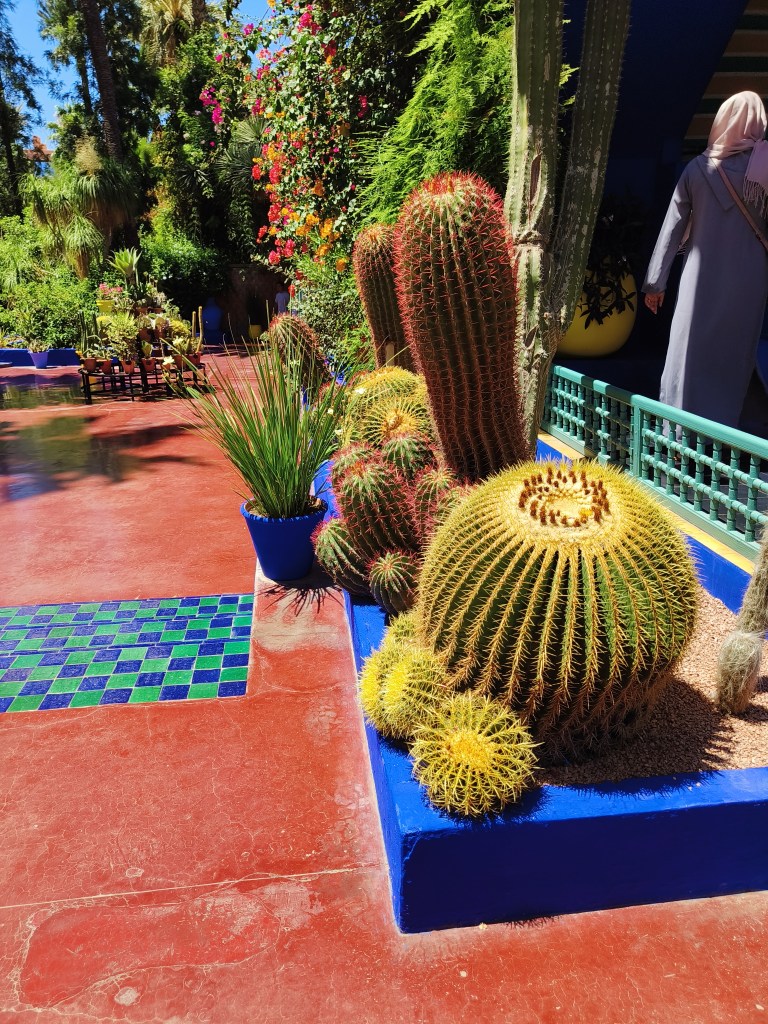
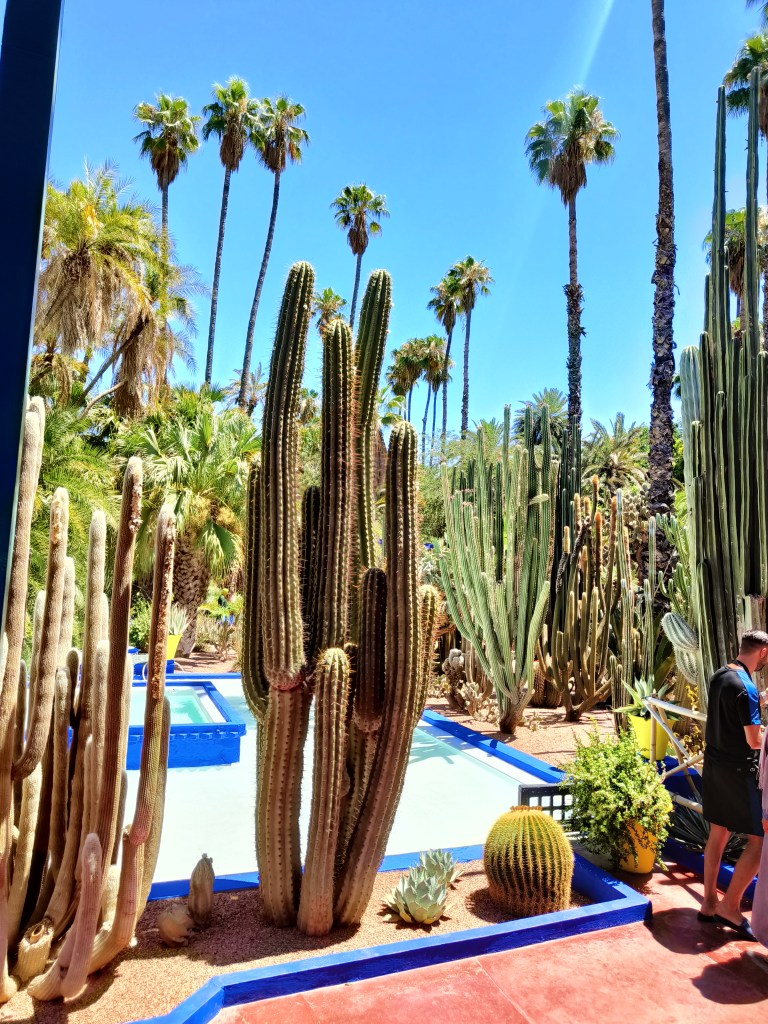
Jardine Majorelle – the Botanical Gardens, Marrakesh
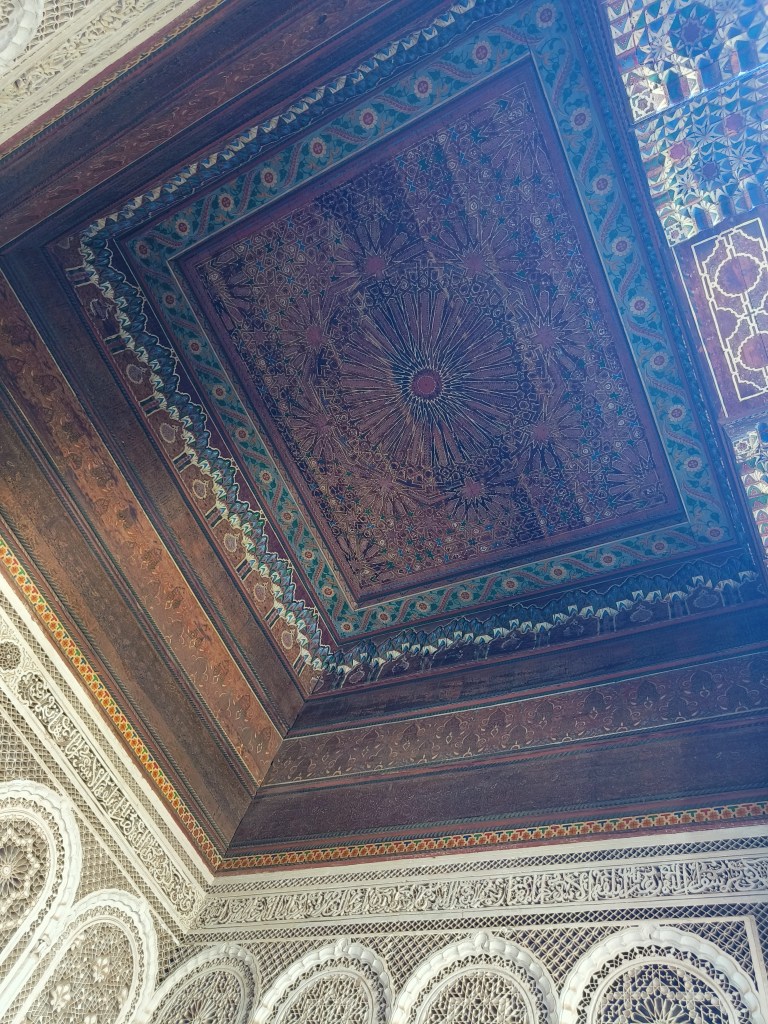
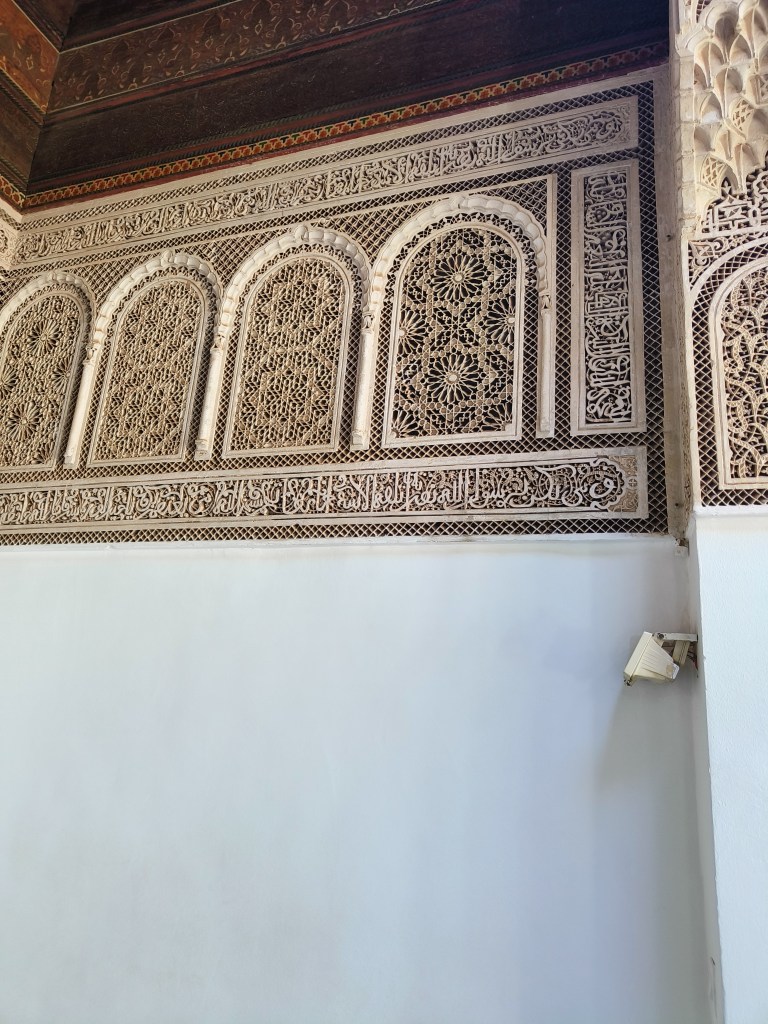
Bahia Palace – the Grand Vizier’s residence, Marreksh
- Day 3 – Sat – We did a day trip to Ait Benhaddou (ABH) in the Atlas Mountains, which are one of two major mountain ranges in Morocco, along with Rif mountains. ABH is famous for being a stop on the caravan route and as the backdrop for scenes in Gladiator and Game of Thrones. ABH has earthen houses from the 17th century (it has been declared a World Heritage site), which keep them cool during the hot summer months. We took a separate cab for the three of us and realized that we could have taken the group travel option, which would have cost us half of what the cab cost us.

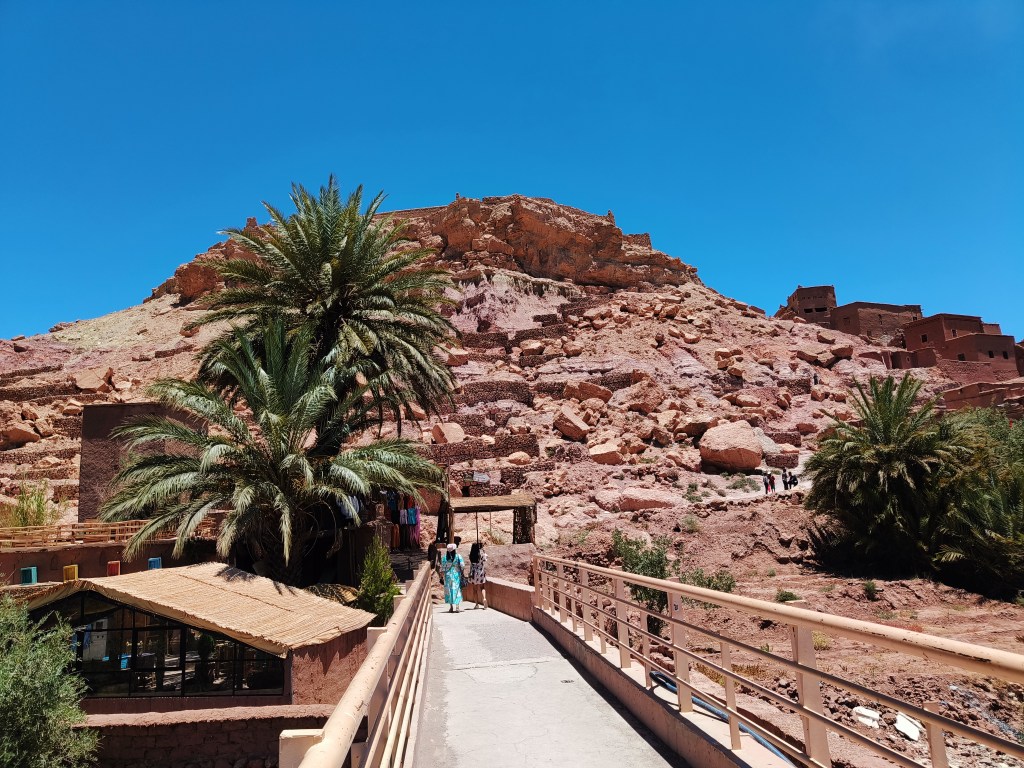
Ait Benhaddou – Morocco’s Hollywood
- Day 4 – Sun – Visited Bin Youssef Madrassa (BYM). Madrassas are educational institutions where students reside and study religion and philosophy. BYM was commissioned in the 1500s by the then sultan Abu Inan Faris. Once again, BYM is symptomatic of the splendid Moroccan architecture with intricate patterns and rich colors.
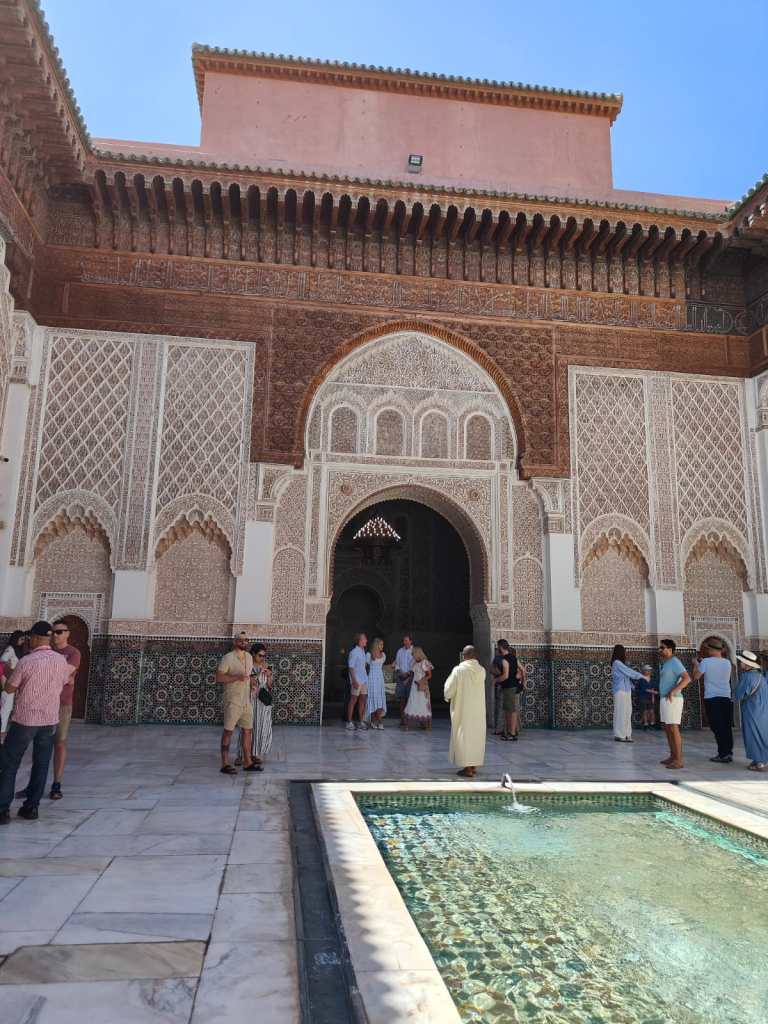

Bin Youssef Madrassa – Typical Moroccan architecture, Marrakesh
- Day 5 – Mon – Left RAK for Fes by Ryanair, the EU low-cost airline. It was a short 1-hour flight. As with RAK, we were dropped off a full kilometer away from our Riad. The owner’s son (Aziz Idris) was there at the spot where the cabbie dropped us and took us by walk to the Riad. It was a 1 km downhill walk with our luggage right through the middle of the Medina with all the glittering bazaars! The owner, Abdul Kareen, was like a father-figure to us. Father and son helped us plan the rest of our trip to Fes. In the evening, we searched for a vegetarian restaurant (Veggie Pause) and had a superb Buddha bowl for dinner!
- Day 5 – Tue – We did a day-trip by bus to Chefchauen, which was around 180 kms – a four hour trip. Chefchauen is famous as Morocco’s the Blue City. The ride was very scenic – undulating hills with Olive and Almond orchards typical of this part of Morocco. As we neared Chefchauen, it was a riot of pink (Aralis in Tamil) on either side of the highway. As with RAK and Fes, Chefchauen has the souqs inside the Medina – again, the same fare – ceramics, shoes, fashion jewelery. etc. The standout, of course, was the blue color, which was everywhere. The city was founded by Moulay Bin Rashid in 1471. We visited the fort (Kasab Moulay bin Rashid), which proved to be a waste of money (MAD 160), as the display boards of its history were in three languages (French, Spanish and Italian), without any English translation. We took the bus back to Fes and reached there at 8.30pm – we had wonderful veggie rolls for dinner at a vegan restaurant called Culture Box.
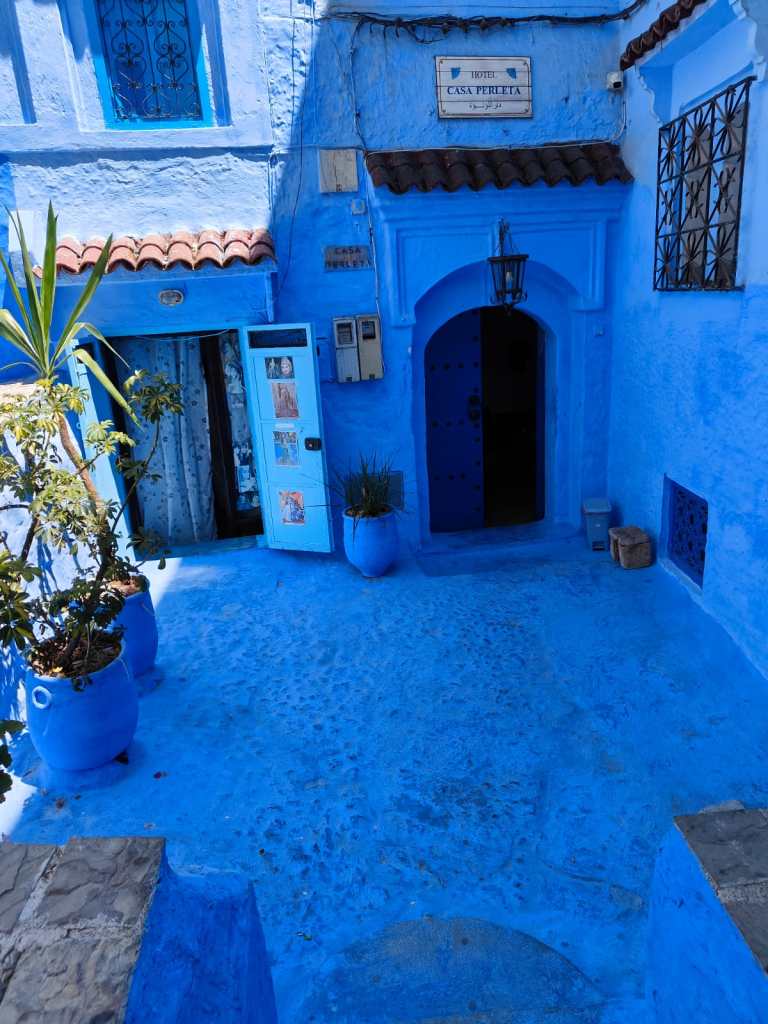
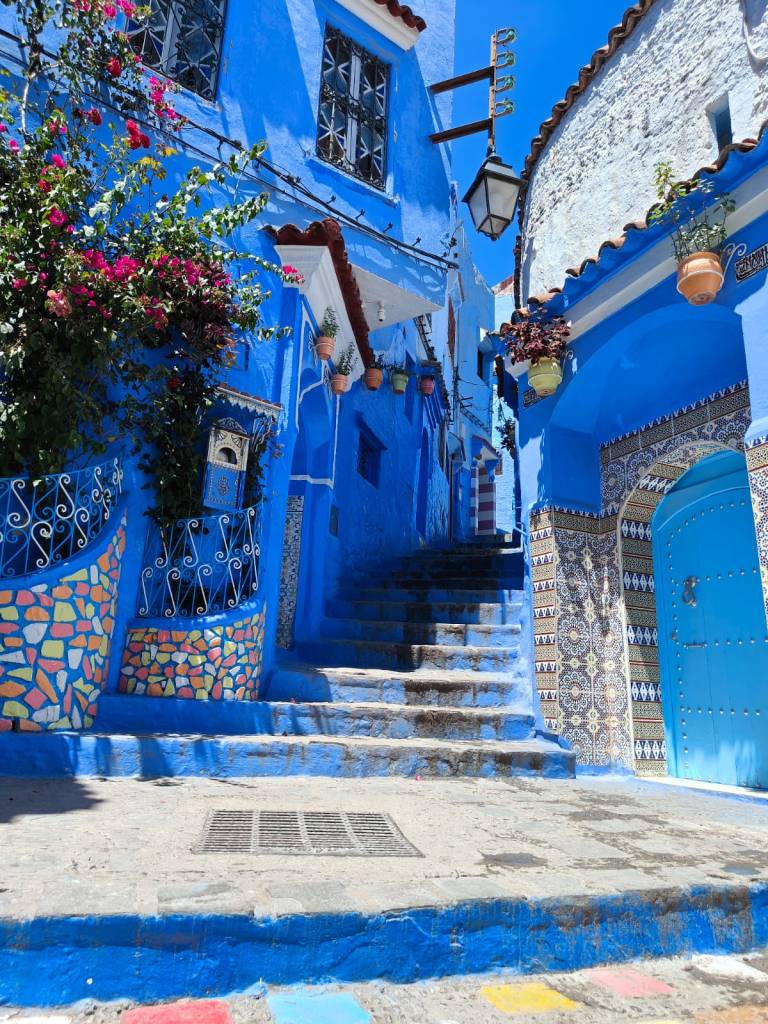
Chefchauen – the “Blue city”
- Day 6 – Wed – It was a day of local sightseeing in Fes – we travelled through different sections of the Medina –– carpets, shawls, ceramics, shoes, tannery, dyeing, dresses, brass / copper handwork, food – Fes is known for its very, very, narrow streets – 9,400 of them! An interesting historical place is the University of al-Qarawiyyin, reputedly the world’s Oldest university. Initially founded as a mosque in Fes in 859 CE, it was subsequently expanded to include the educational centers. The Medina also houses a nice furniture museum, which has furniture typically used in Moroccan architecture.
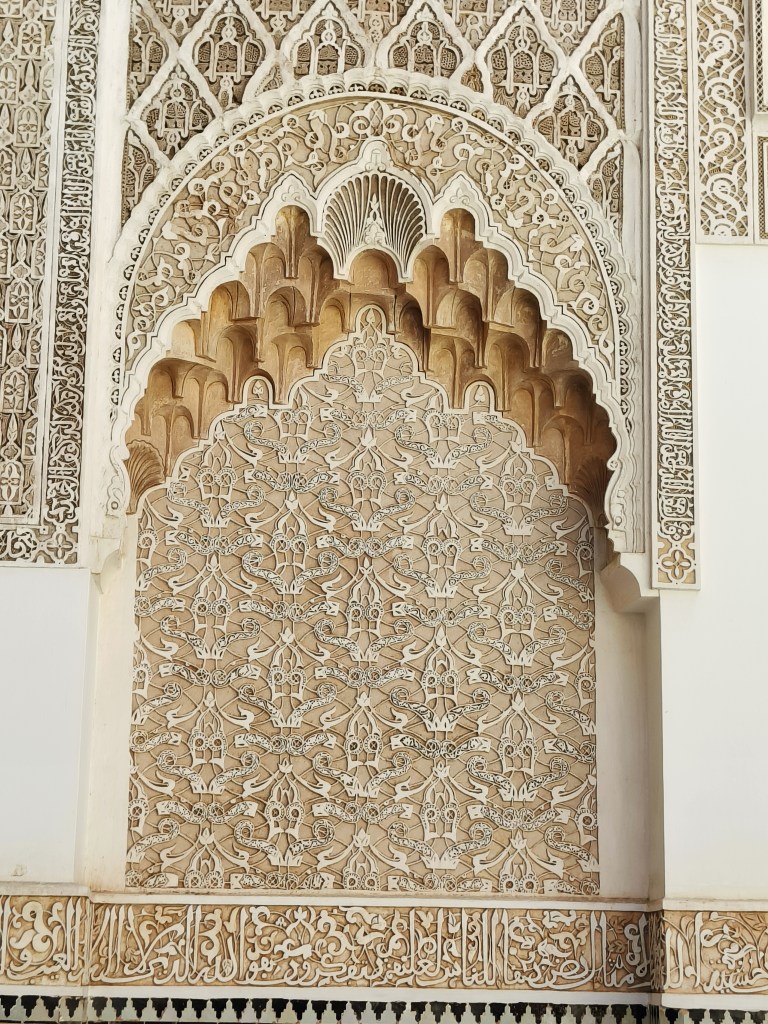

Al Qarawiyyin – the world’s oldest university – Fes
- Day 7 – Thu – Day trip to Volubilis, Moulay Idris, and Meknes – Volubilis is a Roman city built in the third century BC – the Romans were here for a couple of centuries and the empire collapsed when the Berbers attacked them in the 3rd century CE. Volubilis is well-preserved with its arched gateways, its distinctive art and history. After Volubilis, we passed by Moulay Idris, named after the founder of Fes in 9th century; We then stopped at Meknes, which was Morocco’s capital city during the rule of Moulay Ismail during1600s to early 1700s. We visited the mausoleum of Moulay Ismail, who is notorious for having had 100+ wives and 500+ children!
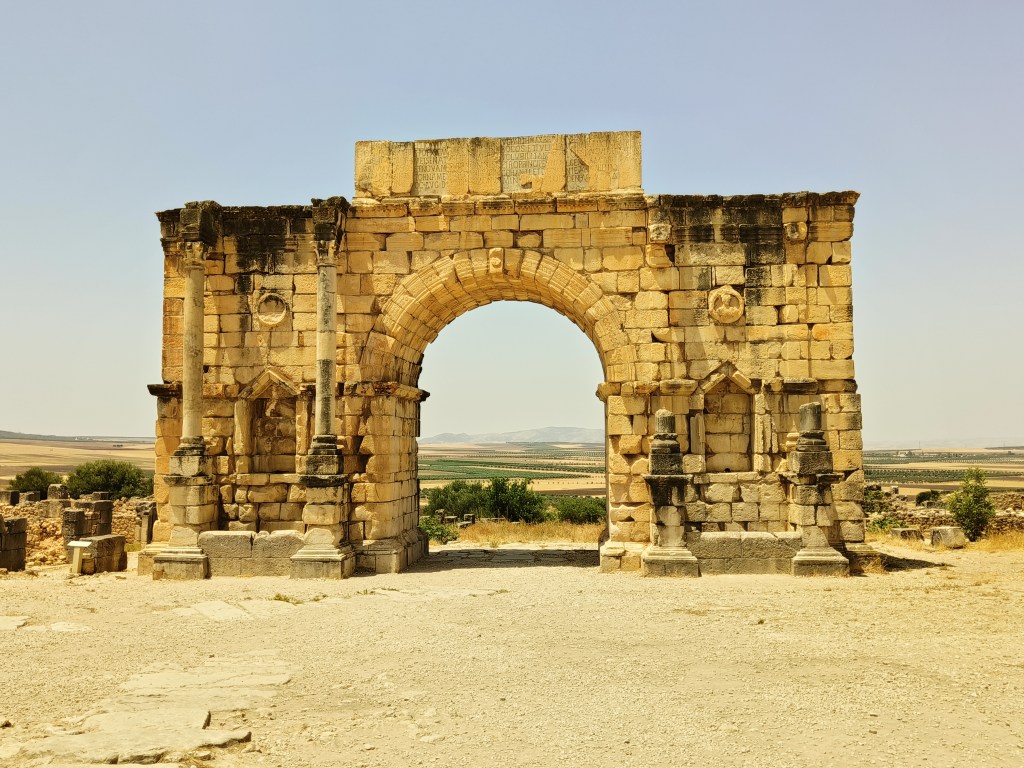
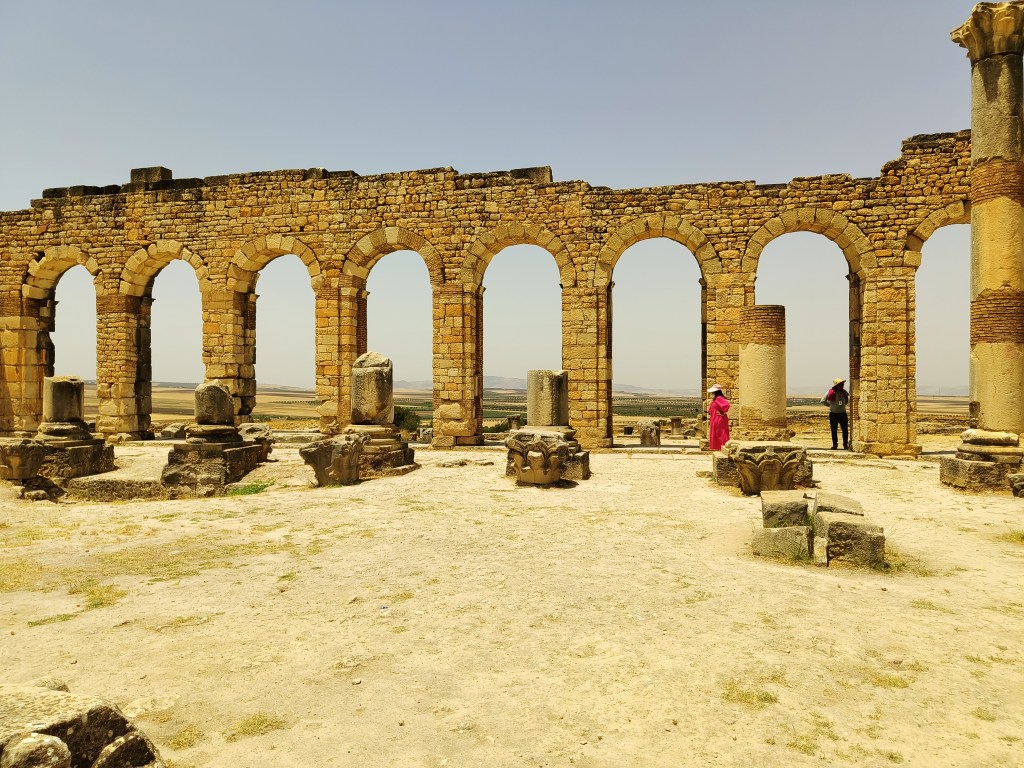
Volubilis – Roman ruins from 1st century CE
- Day 8 – Fri – We left Fes for CMN by train. We visited Hassan II mosque, which is reputedly the second largest in Africa. Its beauty is especially enhanced as it is by the Atlantic coast. We also visited the Arab League Garden. It was in CMN that we had the nightmare of the trip – I was holding my phone in my right hand as we were seeing the direction to a restaurant. A bike-rider came zipping by, grabbed my phone and sped away before we could react. A couple of good Samaritans took us to the local police station to file a case. The police basically said it would not serve any purpose. Fortunately, this happened towards the fag end of the trip and I had to manage without a phone for the rest of the trip – a case of forced digital detox!
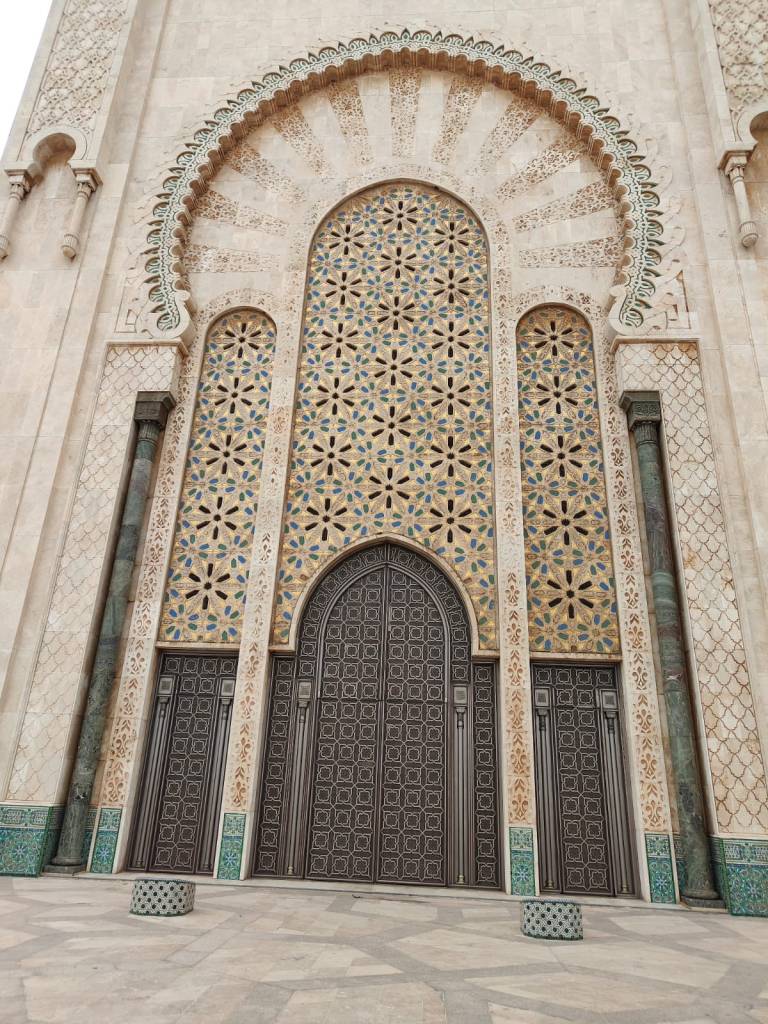
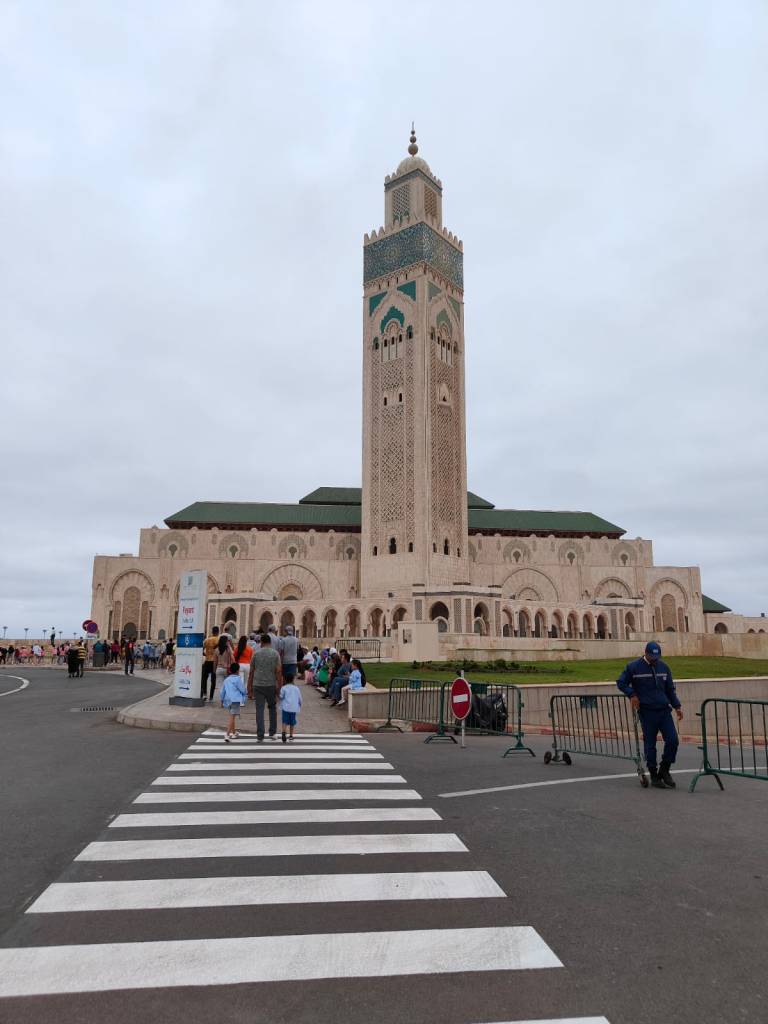
King Hassan II mosque, Casablanca – Africa’s second largest
- Day 9 – Sat – we did a day trip to Rabat, which is an hour’s train journey – both CMN and Rabat are modern cities and have a French look and feel to them with modern boulevards and cafes. Rabat is also the capital city of Morocco. We visited the Hassan tower, a semi-finished mosque which was commissioned in the 12th century by the Almohad dynasty. When initiated, it was meant to be the largest mosque in the world but was left incomplete due to the death of the Caliph at the end of the 12th century. We also visited the Kasbah (Citadel / Fort) Oudaya, again originally built in the 12th century and then renovated many times subsequently.
- Day 10 – Sun – we took the afternoon flight from CMN to Doha, Doha to Delhi. A long, 5-hour layover in Delhi and then a Vistara flight to Chennai.
 Shankar_worldcitizen
An interesting travelogue, Shankar! You have captured the history and culture of Morocco vividly. The beautiful photographs embellish the story! The colour coded cities is interesting to know!
The last few days of your vacation seem to have been a “digital detox” for you, though not by choice!
Ravi
LikeLike
Thank you, Ravi!
LikeLike
Nice travelogue Shankar and super photos. Thanks for sharing about Moroccan history and culture.
LikeLiked by 1 person
Thank you, Phani. Glad you enjoyed reading it!
Shankar
LikeLike