A nation is a people and
A people are their stories!
Day 1 – From Cairo to Giza
Cairo, much like an Indian city
If I told you that the city was congested, dusty, with unruly traffic, and honking, but also has warm, friendly and large-hearted people, you may think of any Indian city. Interestingly, all of these descriptions also fit Cairo to a tee! Perhaps due to the similarity of cultures, Egyptians, while generally welcoming of all tourists, seem to have a special place in their hearts for Indians. You will often hear them say “I love India(ans)”. They will also ask about Shah Rukh Khan and Kareena Kapoor as though they were our neighbors!
The quintessential Egyptian
Right after we landed in Cairo, we were greeted by Mohammed, the chauffer that the hotel had sent to pick us up. The 45-minute ride with Mohammed to our hotel in Giza, was to set the tone for the warmth and hospitality that the average Egyptian treats you with. Mohammed was fun loving and a bundle of energy. He played some lively (if loud) Egyptian music and, if he was not driving, he would have started dancing! There is the quintessential Egyptian for you – they all love music and dance.
Giza in a time warp
Since our first pit-stop was the pyramids, we had booked to stay at Giza, thus avoiding the usually heavy traffic from downtown Cairo to Giza. It proved to be a good decision and, not just because of the proximity to the pyramids – it gave us a much better insight into life in Giza. Giza, home to three of the largest pyramids that man has ever built, is caught in a sort of time warp. It takes you back in time with few of the trappings of modernity and many signs of eons gone by – horses and camels for transport and dung-laden narrow, cobbled streets. Our hotel was literally a stone’s throw from the pyramids – we enjoyed a stunning view of the pyramids from the terrace of the hotel we stayed in – at dawn, dusk and
at all times in between! More on the pyramids later in this blog.
Nile cruise, belly dancing and Tanoura
The concierge at our hotel convinced us that a cruise on the Nile was a not-to-be-missed ritual on your itinerary – what with music, belly dance and Tanoura dance. And, so we went on a cruise the first evening. While the music and belly dance were underwhelming, the Tanoura dance was a stand-out that made the evening outing worth the while! Tanoura is the name of the dance form as well as the skirt that the dancers wear. It is a sufi art form where male dancers dance by whirling round and round, in a trance-like motion. While it originated as a spiritual, Sufi dance form, it has also morphed into a commercial art form. There was this 10-year old boy who was spectacular and making impossible colorful patterns with his skirt, while continuously whirling around for over 45 minutes – easily
outclassing his dad!
Day 2 – The Giza Pyramids

View of the three Giza pyramids and the Sphinx from the terrace of our hotel (The Pyramid Inn). In the foreground is the Giza city
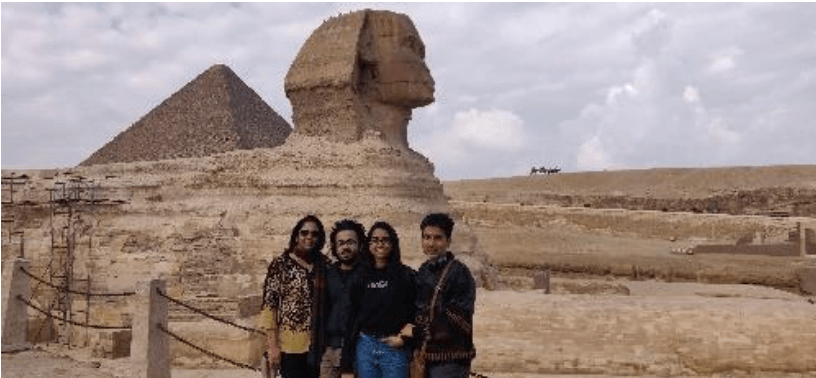
The majestic Sphinx in the background
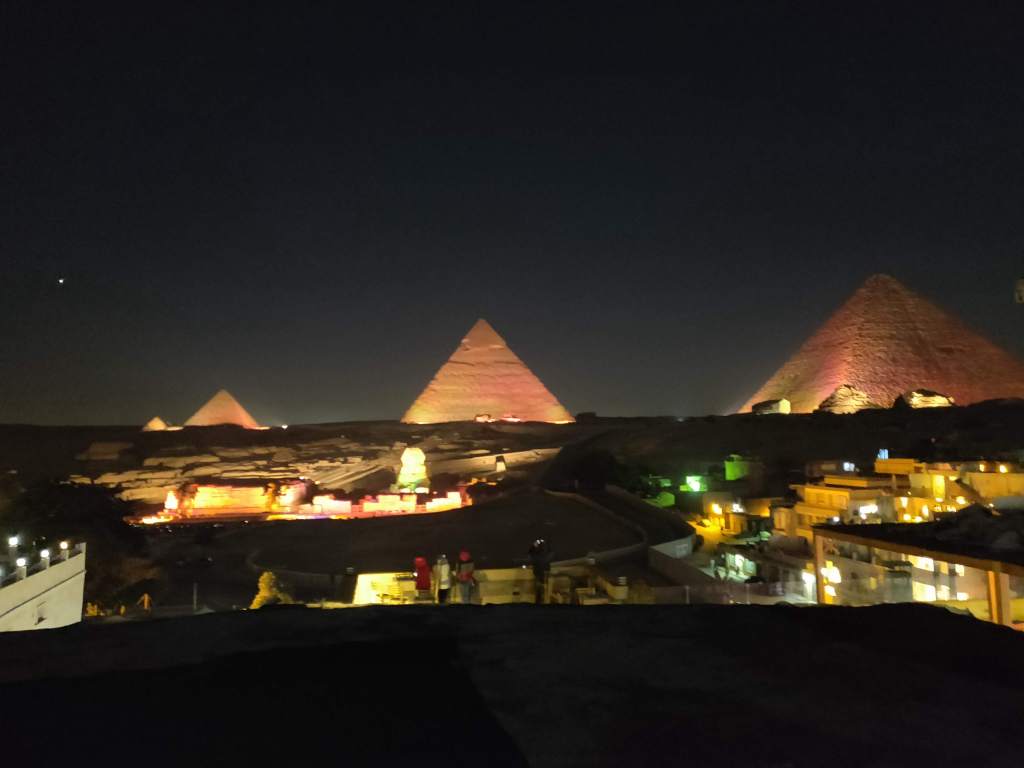
The Giza pyramids and the Sphinx looking eerie and ethereal at the same time – lighting was part of the sound and light show – Magical!
The eternal magic of the pyramids
Through our hotel front desk, we engaged Abdul as our exclusive guide to take us on a tour of the pyramids. No amount of gazing at pictures or watching documentaries about the Giza pyramids prepares you for the real thing. Think of this – at 481 ft, the largest of the Giza pyramids built in memory of Khufu, the pharaoh, was the tallest man-made structure in the world for 3,800 years! The scale and precision of the Khufu pyramid are simply mind-blowing – the facts are all out on the net and I do not intend to repeat them here.
We went through one of the tunnels that crisscross the Khufu pyramid leading on to the King’s chamber. You have to literally walk hunched and single file through much of the length of the tunnel and at impossible gradients. One cannot even begin imagining how they would have built this close to 5,000 years ago with none of the tools and equipment that we take for granted now. The chamber itself is a small room with the sarcophagus at one side of the chamber. For us, it was a near-spiritual experience.
By the time, we were out of the Khufu pyramid, it was lunch time and we parked ourselves in the vast open space between Khufu and Khafre pyramids. As we munched into the teplas that we had packed from home, a large Egyptian family settled down near us for lunch as well. Once again, the Egyptian hospitality floored us – for, the dad came by to offer the food that they had brought with them. We enjoyed eating the bread that they shared and so did they when we shared with them some of our teplas!
At night, we enjoyed the sound and light show at the pyramids from our hotel terrace – it was magical and kind of transported us 5,000 years back in time!
Day 3 – Giza to Cairo
Omar the Bedouin and Shahrzad the faith healer
On the third morning, we decided to explore some of the shops in the hotel neighborhood. Our first stop was at a perfume store run by Omar the (former) Bedouin chief. Omar was at his charming best, having us not only taste the different teas that he served, but also trying to convince us that they had some of the best natural perfumes in the world! We were soon to realize that Egyptians also have a native talent for marketing – you need to have supreme resolve to not getting coerced into buying something from them!
Our last stop in Giza was at an antique store run by Shahrzad, a middle-aged lady, who is also a faith healer. While we had never met a faith healer previously, nor known what they do, we were highly impressed with Shahrzad’s uncanny ability to think in our shoes!
Cairo (the mummy) museum
Sarcophagi, mummies and all the paraphernalia that accompanied them – you might be led into thinking that’s not too much for a museum. However, the Cairo museum is a veritable treasure trove from all of ancient Egypt’s history. Imagine seeing the well-preserved mummies of King Ramses II, King Amenhotep, Queen Hatshepsut among several other royals from 4,000 to 6,000 years ago; enough to give you the goosebumps! Most exhibits at the museum are artefacts excavated from places like Giza, Luxor, Aswan etc. The star attraction and the most crowded section at the museum is the sarcophagus and tomb of the boy king Tutankhamun. While the boy king is believed to have died very young at 18
years, the reason he is so popular is because his tombs contained some of the most extensive, intricate, and valuable funerary collections among all rulers of ancient Egypt. A mask of King Tut, made fully out of 11 kgs of gold, is a standout exhibit.
Day 4 – Cairo
Sharif, the cabbie who wanted to speak in English
We took a cab to go to the Museum of Islamic Art and, as we usually do, engaged in conversation with the driver. Sharif, asked us some questions in Arabic and, when we said we only knew English, he tried desperately to frame his questions in English. Through the short trip, he tried to find the right words to talk to us in English, but couldn’t. His anguish at not being able to communicate in English was so profound, that he kept banging his hand on his head in frustration! We truly felt sorry for Sharif!
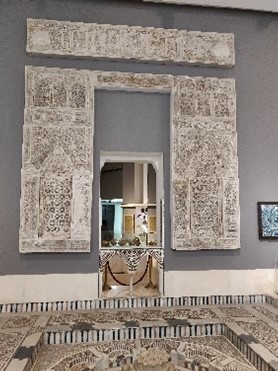
Museum of Islamic Art, Cairo
Egypt was conquered by the Umayyad Arabs in mid-7th century by defeating the Byzantines. This was followed by several different caliphates – the Abbasids, Fatimids, Mamluks, Ottomons. The museum has an exceptional collection of exhibits in wood, metal, ceramic, glass, crystal etc. from 7th century till the modern day. In addition to the sheer artistic beauty of various art works, what was very interesting is the significant progress that had been achieved in science and astronomy.

Khan El Khalili
They say a trip to Cairo is not complete without visiting Khan El Khalili, one of the most famous bazaars located in the heart of Cairo. You can shop here for anything from spices to jewelry to replicas of exhibits at the Egyptian museum! The only item that we planned to buy at KeK was the Rosetta stone and we went about asking at every antique shop – we had nearly given up at the 10th shop when an old gentleman said he would take us to a store that had replicas of virtually every item in the Cairo museum, including the Rosetta stone. He took us through some narrow alleys until we got to this store that was cramped with every imaginable antique from Ancient Egypt. The Rosetta stone has a replica of the
original three-language text imprinted on a piece of stone and we had a budget of 300 to 400 pounds in mind and got a shock when the shop owner quoted 1,500 pounds! I quickly consulted with my wife and we thought it would be a great strategy to ask for half the price. The shop owner feigned that we were pushing him to make a loss on the deal and reluctantly agreed to 750 pounds! Later on in the trip, we were to realize that we were ripped off – we were offered the same Rosetta stone in another store at 400 pounds! The moral of the story for us was that it is best that you get your local guide bargain for
you.

Day 5 – Flight to Sharm El Sheikh
Ronnie and the Coptic Christians
We got talking to the cab driver on the way to the airport and learnt that he was Ronnie, a Coptic Christian. Ronnie told us that Christians and Muslims in Egypt share a common history, culture and language. We asked him what percentage of Egypt’s population he thought was Christian and he said it was one in four. Interestingly, when we later googled the topic, we learnt that Egypt was one of the first countries in which Christianity took hold in the first century AD. However, only around 10% of Egypt’s population today is Coptic Christian.
Sharm El Sheikh –The European Beach Town in Egypt
Our daughter (Samrita, Sam for short) had picked SeS over Hurghada as the snorkeling / diving destination. While the flight from Cairo to SeS was less than an hour, it was delayed by a couple of hours and we ended up spending the whole day in the logistics of getting there. SeS is at the southern end of the Gulf of Aqaba and we flew over terrain straight out of another planet – no speck of greenery, filled with barren and jagged mountains and deep canyons. Suddenly from this landscape, you get to fly over a pretty little beach town and you are all ready to land.
SeS is different other Egyptian cities and has a sort of European look and feel to it. No surprise then that it gets plane-loads of tourists from many European countries. While the bombing of a Russian plane in 2015 had impacted tourist arrivals, things are returning to normal – ironically, a majority of tourists are Russian – a fact acknowledged by most shopping signage including Russian script!
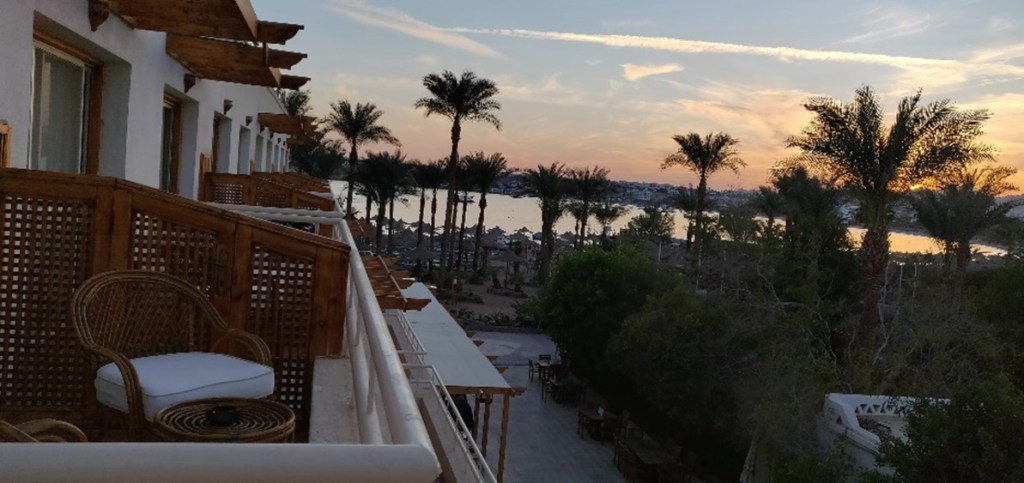
View from the balcony of our hotel (Oonas Dive Club) at SeS
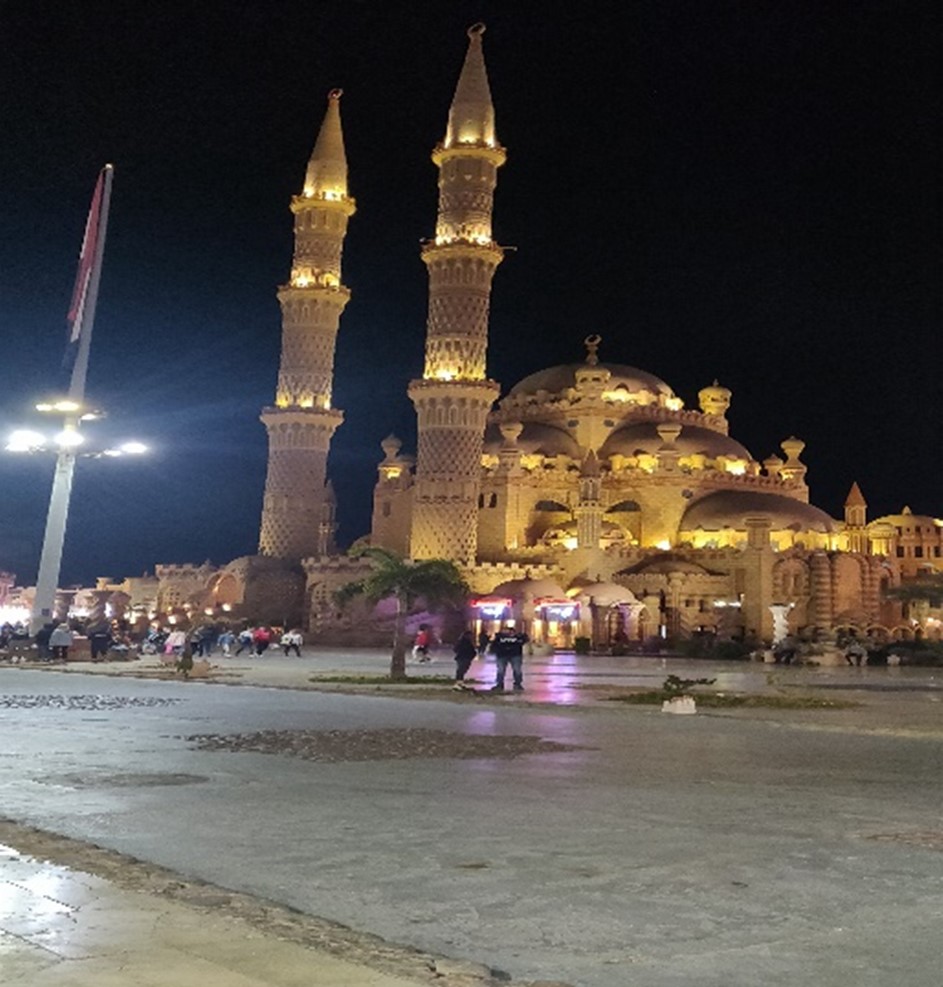
The beautiful mosque stands majestically in the old part of SeS, in the midst of a sprawling shopping area
Five days into the trip, our taste buds were longing for some Indian food and our hotel concierge suggested Rangoli, an Indian restaurant at Movenpick hotel. We asked for a cab, not realizing that Movenpick was literally next door!
The Movenpick hotel was truly beautiful, with terraced gardens and villas overlooking the Naama Bay. The ambience at Rangoli was authentically Rajasthani and the view of the Bay gave one the feeling of being in the Lake Palace Hotel in Udaipur. The food was no less, curated by Raj, an Indian chef, who came by to engage with us. We stuffed ourselves up with enough Indian food to last us for the rest of the trip!
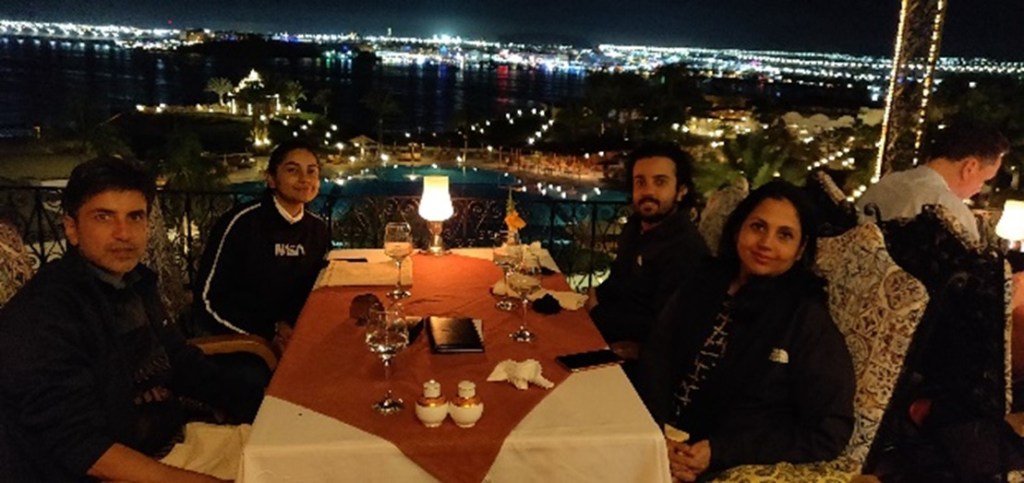
At the Rangoli (Indian) restaurant in Movenpick hotel (Sharm el Sheik). Naama Bay in the background
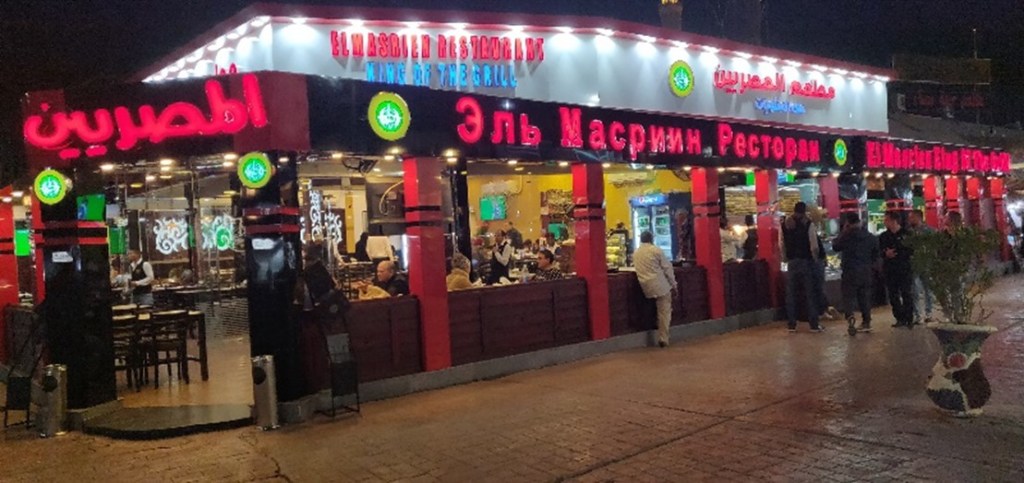
Shopping area in the old part of SeS – almost all shops have signage in Russian!
Days 6 and 7
Hammam and the Egyptian dinner
We struck friendship with Hammam, one of the staff at the hotel front desk. We asked him about the old part of SeS and he offered to take us out for an authentic Egyptian dinner and to serve as our local guide that evening. He said he wasn’t doing it for money, but to just show how hospitable Egyptians can be. Hammam insisted that we take one of the shared taxis, which serve as public transport. We paid 8 pounds for the trip that would have cost 100 pounds if we had taken a private taxi! More than that, it gave us a flavor of local life, instead of the usual touristy experience. The central mosque of SeS was set in the middle of a shopping center and provided a spectacular blend of the old and the new. Hammam took us to a local restaurant and carefully curated our vegetarian menu. Our dinner was just fabulous and easy on our pockets too! Once again, Hammam added big-time to the Egyptian hospitality quotient!

With our wonderful Egyptian host, Hammam, who hosted an authentic Egyptian dinner for us at SeS

The mouth-watering Egyptian fare – all vegetarian!
Corals at Ras Mohammed National Park (RMNP)
Our son (Shreyas) and I picked the snorkeling option while our daughter was game for the more adventurous scuba diving at the Ras Mohammed National Park. Sowmya (my wife) decided to stay put at the hotel and enjoy the quietude). SeS in general and RMSP in particular are supposed to be one of the best locations for corals, at least in this part of the world. For us, it was rather disappointing because, while the corals were alive, they were mostly an off-brown monochrome. Nor was there an abundance of colorful fish that you expect in thriving coral ecosystems.
Falling sick and finding world-class healthcare
In the course of her scuba dive, Sam had gotten “poisoned” by carbon dioxide build up, ended up with a splitting headache and repetitive bouts of vomiting over several hours after her return from the dive. Our hosts at the hotel helped administer additional oxygen but nothing helped relieve her condition. We took a decision to take her to Sharm International Hospital (SIH). Since it was a government hospital, I was apprehensive about the service levels. However, our experience at SIH was beyond anything I could have asked for. The duty doctor was very efficient and empathetic and quickly figured that Sam’s condition was also triggered by migraine. After a round of drips administered in the
emergency room, along with medicines, Sam became much better and we headed back to our hotel in an hour. The service levels were simply world-class.
Day 8
Our last stop was Luxor and, since there was no direct flight from SeS to Luxor, we had to fly to Cairo and then to Luxor. The entire day was spent at airports and flights, what with delays again with Egypt Air flights. We reached Luxor late in the evening. Our hotel, Nefertiti, was right at the entrance to a bazaar and gave us a quaint old-worldly feeling!
Day 9
Luxor, the ancient Egyptian capital
For much of the ancient Egyptian history, Luxor served as Egypt’s capital and was its most spectacular city. Today, it still retains its grandeur, and houses many of the pharaonic sites – Luxor temple, Karnak temple, Valley of the Kings, Queen Hatshepsut’s mortuary etc. We just had one day at Luxor and decided to visit Karnak and Luxor temples.
Karnak: City in a Temple?
Firstly, everything about the Karnak temple is grand and mammoth. Every pharaoh added to the temple complex over two millennia (2000 BC to 350 BC). Four thousand years later, there are few other temple complexes in today’s world to match its beauty and majesty. It is a virtual city in a temple!
From the Grand Procession Way of Sphinxes to the Great Temple of Amun, Ramses II, Osiris, to the majestic columns of Khonsu, to the Obelisks, you will need a whole day to take in the massive scale of architecture and the history behind each of them. Without a guide, you will not do justice to enjoying the visit to Karnak temple.
Luxor Temple
Although not of the scale of Karnak, Luxor Temple houses massive architectural pieces built by Amenhotep III, Tutankhamun, Ramses II and, also interestingly, Alexander the Great! It is believed that many of the Egyptian pharaohs were crowned at Luxor. Another interesting feature is that, during such coronations and festivals, processions were held all the way from Luxor temple to Karnak temple, some three kilometers away.

The avenue lined with ram Sphinxes at the entrance to the majestic and mammoth Karnak temple

The huge columns built by Ramses II at Luxor temple
Back to Cairo one last time!
Our evening flight back from Luxor to Cairo was fortunately on time and we reached the service apartment that we had booked for a comfortable night’s sleep.
Day 10
We flew from Cairo to Dubai for a two-day break prior to returning to Chennai.
Dedicated to the people
As we reminisce our trip, it was all the interesting and caring people who made the trip such a beautiful experience as much as the history and the geography. It is to them that we owe a big thank you to have made our trip memorable for a lifetime – Mohammed, Omar, Shahrzad, Abdul, Ronnie, Sharif, Hammam, and others whose names we didn’t get to know!
 Shankar_worldcitizen